

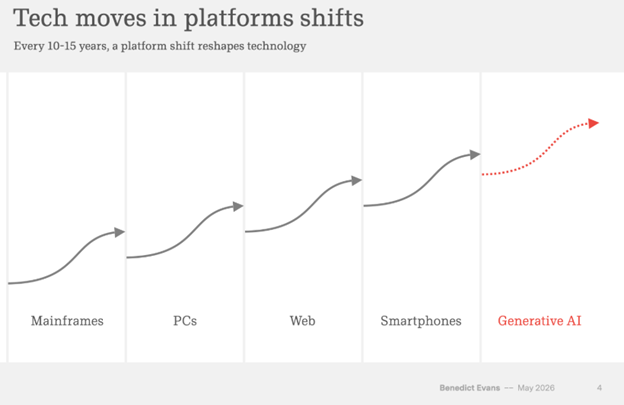
AI is the next platform shift and it is here. Private companies are already an order of magnitude larger than in prior cycles.
The vast majority of VC dollars are being deployed into AI. These dollars are increasingly concentrated in a small number of companies, backed by a small number of funds, backed by a small number of LPs.
The democratization of alternatives has the promise of broadening access to more investors, including retail. Asset managers, from BlackRock down, are building retail-focused products to solve this problem.
Public VC (“PVC”) in a closed-end fund wrapper is the right structure to enable retail investors to benefit from the AI boom.
The problem today is that public VC managers are predominantly buying late stage positions in companies where a significant proportion of value has already been captured. These products also run the perception risk of retail becoming the “bag holders” for institutional investors offloading their late stage positions.
What if there was a product that invested at Series B to enable retail investors to capture more of the upside?
Enter Public VC
Destiny (ticker: DXYZ) was the first of the current generation of public VCs, offering access to SpaceX and other companies, in a publicly traded closed-end fund wrapper. The listing was in early 2024. DXYZ has subsequently raised $500m+ in the public markets and continues to trade at a significant premium to NAV. There is clear demand from retail for high quality private assets.
Yet the longer term sustainability of trading at a premia to NAV for late stage PVCs is unclear. The SpaceX, Anthropic and OpenAI IPOs are upon us. Retail will soon be able to buy these names direct at par.
Destiny, and similar products such as Fundrise (ticker: VCX) & Robinhood Ventures (ticker: RVI), has only been in existence since the three marquee assets were already at mature valuations. They have bought these assets at a late stage.
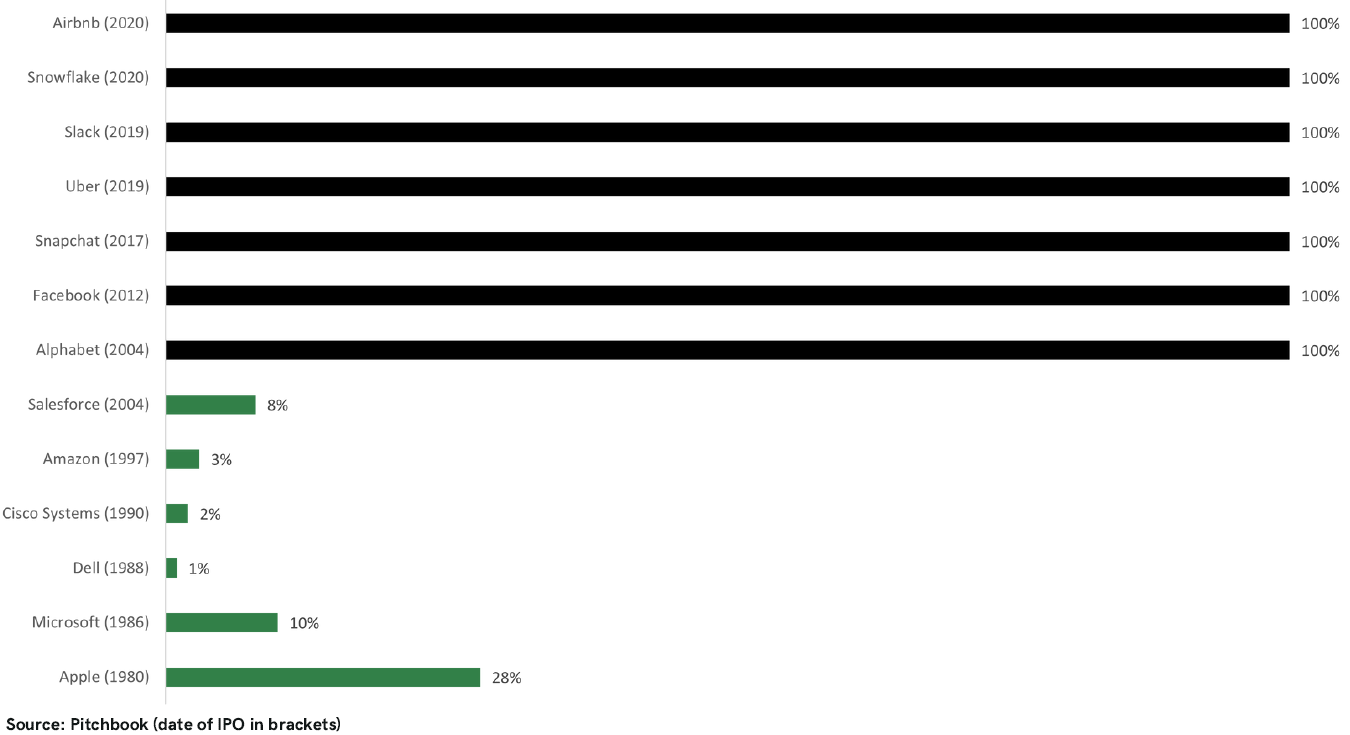
Companies are staying private longer and at higher valuations. SpaceX is 20+ years old. Figure 1 is an old Pitchbook slide which shows how 100% of the first $20bn of value is now captured in private markets prior to an IPO, which is a big change from prior cycles. You could add Figma, Cerebras and others to this chart. As well as the three upcoming IPOs.
Figure 1. Proportion of first $20bn in value captured as of IPO (%, select IPOs)
In addition, the quality of the security that PVCs own in these late stage entities can be subpar. Many of the positions are in multi-layer SPVs where the underlying asset is a forward contract that the companies are disputing. See Anthropic’s latest position on SPVs.
A Series B vehicle can capture more value
SignalRank is not available to retail today. But our product offers our own investors the opportunity to buy today the power law companies of tomorrow in a diversified structure that only owns pristine direct on cap table preferred Series B stock. (Technically, we own positions through our own SPVs which are direct on cap table, structured this way to allow for the profit share to our seed partners).
What if you had invested in this fashion in the Series Bs of SpaceX / Anthropic / OpenAI? Let’s take a look at each one in turn:
OpenAI has of course had an unusual funding history, whose rounds are not so legible. Hard to calculate with public information.
SpaceX raised a $20m Series B at ~$160m post-money in 2005, according to Preqin. At an IPO valuation of $1.7tn, the valuation has increased over 10,000x. The actual returns will be substantially lower due to dilution (and with any liquidity in the meantime). 2005 was another time.
Anthropic is the more relevant example if we want to understand what potential Series B returns could be for future AI power law companies. Anthropic’s Series B was in 2022, backed by FTX amongst others. According to Preqin, this was a ~$600m round at ~$3.8bn post-money. At a rumored $1tn valuation, this is a 250x increase in valuation. Again, the returns to investors will be lower due to dilution.
What if retail investors could have invested in Anthropic at the Series B? What would an investment product look like holding these types of future power law companies?
This is the exam question that SignalRank seeks to solve.