

This article was co-written by myself and my Openclaw agent. The thesis is mine, and most of the writing. But Openclaw is definitely my writing buddy.
Some venture investors love binary arguments because binary arguments disguise judgment.
Concentrated funds say (dismissively) that diversification is an index fund for people without conviction. Diversified funds (also dismissively) say concentration is ego dressed as strategy.
Both are right about the bad version of the other. Both are conveniently quiet about their own failure mode.
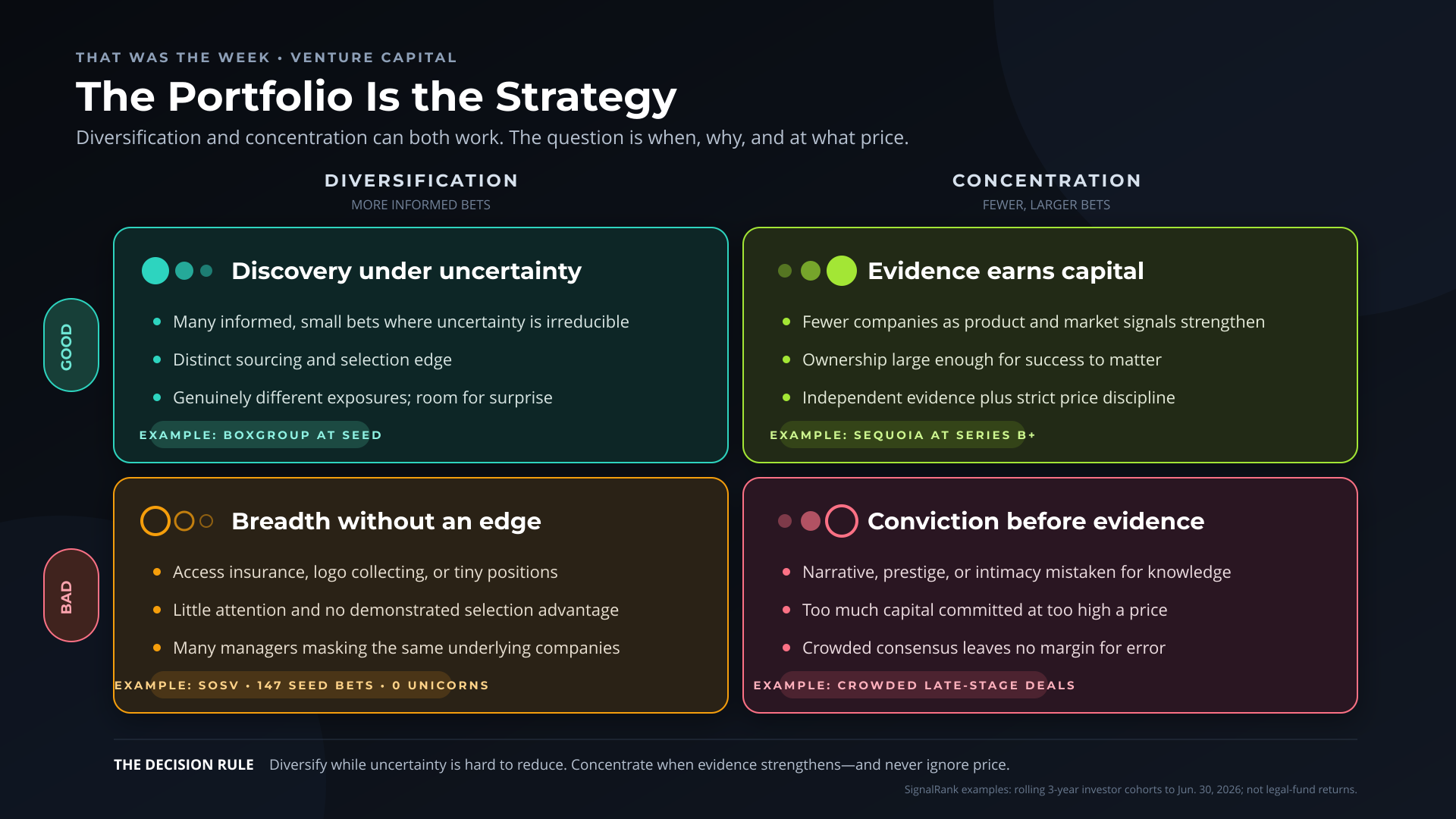
There is good diversification and bad diversification. There is good concentration and bad concentration.
The number of companies in a portfolio tells you almost nothing on its own.
The real question is what the investor knows when the decision is made, and how right are they.
At seed, uncertainty is irreducible. The product may not work. The market may not exist. The founder may be brilliant, impossible, or both. The company may become something entirely different from the pitch. A small number of outcomes will produce most of the returns, and those winners are unusually difficult to identify before the evidence arrives.
That is where diversification can be excellent strategy. Done well, it expresses conviction about the shape of the market. A skilled seed investor can define a domain, develop a distinctive source of deal flow, make many small investments, and let reality reveal which companies deserve more time and capital. The portfolio is an instrument for discovery.
I have included a few articles below published this week
BoxGroup is a useful example. Gené Teare’s analysis of the 2026 unicorn class found that BoxGroup was the only seed specialist among the 10 investors that had backed the most new unicorns. It ranked third among seed investors despite deploying far less capital than the multistage giants around it. That is good diversification: many informed shots, a repeatable selection edge, and enough exposure to capture outliers.
Africa currently shows the cost of losing that layer. Grégoire de Padirac reports that AI has made prototypes cheaper and brought more founders to the starting line, while the $100,000 to $500,000 first cheque has been shrinking for three years. Capital is concentrating in established managers and later rounds just as experimentation becomes less expensive. That is backwards. The earliest stage is where a market most needs investors willing to finance discovery across many uncertain attempts.
Diversification becomes bad when it stops being a discovery and selection system and becomes access insurance.
Large multistage firms increasingly write seed cheques into dozens or hundreds of companies because they want the right to compete for later rounds. The small cheque buys a logo, information, and a place near the table.
The fund may call this diversification, but the economic purpose is often optionality for a much larger pool of capital. If the firm has no special edge at seed, gives little useful attention, and expects later investors or market momentum to identify the winners, the portfolio is broad without being thoughtful. Later it concentrates with far larger checks into a smaller number of outliers.
Not to single them out because there is much to like, but SOSV is the clearest recognizable example in the current SignalRank data. In the rolling three-year seed cohort ending June 30, 2026, it backed 147 companies, produced no unicorns (so far), recorded an average marked MOIC of 2.40x, and ranked 432nd.
By comparison, among the 15 seed investors with at least 100 companies, median marked MOIC was 3.51x. SOSV was second-lowest. This was not a single snapshot: its rolling cohorts in 2023, 2024, 2025, and 2026 each contained between 147 and 204 companies and produced no unicorns. The marked MOIC ranged from 2.13x to 2.83x. These MOICs are estimates based on subsequent valuations so will certainly not be accurate, but will be directionally correct.
Those figures do not establish the net return of every SOSV legal fund. Its sector and geographic mix may mature differently, and private marks are not distributions. They do show a broad portfolio repeatedly failing to produce the outliers or appreciation visible in stronger diversified seed strategies within three years of the seed round. On the evidence available, that is bad diversification: breadth without a demonstrated selection edge.
It is tempting (emotionally) to put Sequoia in that category. The data says not to.
I queried SignalRank’s rolling three-year investor data through June 30, 2026. At seed, Sequoia backed 77 companies, of which 14 had become unicorns. Its 18.2 percent unicorn efficiency ranked first, and its average marked MOIC was 9.81x. Among investors with at least 20 seed companies, the median unicorn efficiency was zero. Whatever one thinks of a large multistage firm operating at seed, Sequoia’s observed seed results are not evidence of bad diversification.
They do reveal something more interesting. Sequoia’s portfolio narrows as information improves.
At Series A, it backed 80 companies and 22 became unicorns, a 27.5 percent hit rate. At Series B, the portfolio fell to 53 companies, with 27 unicorns and a 50.9 percent hit rate. At Series C, it was 40 companies and 29 unicorns, or 72.5 percent. At Series D, it was 27 companies and 22 unicorns, or 81.5 percent. Sequoia ranked first at seed, Series B, Series C, and Series D, and second at Series A.
That is the shape of a sensible multistage strategy. Explore broadly when uncertainty is high. Concentrate as evidence accumulates. Seed creates the field of view. Series B and later turn information into larger conviction.
This does not prove that every Sequoia fund, partner, or individual decision was well constructed. SignalRank’s data is at the investor level, not the individual fund level or the partner level.
Unicorn status and private marks are not cash distributions. Recent cohorts have not fully matured. But the stage progression is too clear to describe Sequoia’s seed activity as bad diversification. A fairer conclusion is that Sequoia-like firms risk bad diversification when seed becomes merely an access strategy. Sequoia itself appears, on current evidence, to have an edge that makes the broad seed portfolio productive.
Series B is where concentration can become good because the decision is no longer being made in the dark. There is a product, a team, customer behavior, a price, a growth rate, and evidence about whether the market is pulling. The investor can compare a company with its cohort rather than with a story. Concentration at that point can reflect selection rather than faith.
This is also the logic behind SignalRank. We only score a company for an investment at Series B.
Beyond that the score relies on all of the investors in the round. We do not argue that one brand is always right. We track the whole Series B market and select from across it. No single top-tier investor is enough to make a company investible.
The ‘company score’ we rely on has been more predictive than simply following a famous fund.
Good concentration is not loyalty to a manager. It is the willingness to put more capital behind a smaller number of companies after multiple independent signals agree.
The changing Series A market shows why timing matters. The median Series A has risen from $4.5 million a decade ago to $19.4 million today, while the number of funds large enough to lead a typical round has fallen sharply. More money is chasing a narrower definition of what qualifies. Companies with real revenue and good growth can be stranded because they are neither speculative enough to sell a category dream nor dominant enough to look inevitable.
That is bad concentration at the market level. Capital clusters around the same signals, the same narratives, and the same companies. Price rises. Selection becomes consensus.
Anthropic is the extreme version. Erin Griffith’s account of the investors positioned to profit from its IPO shows a small group of venture firms, strategic investors, employees, and private pools capturing much of the appreciation before the public gets access. The company may justify the enthusiasm. The portfolio problem exists anyway. If many supposedly different funds own the same late-stage winner at similar prices, an LP has manager diversification and company concentration.
Eric Fitzgerald makes that point directly. An LP can own 15 venture funds and still be making the same bet repeatedly. Mega-rounds captured 81 percent of global venture funding in the second quarter of 2026. Anthropic alone took close to one-third. Counting fund names conceals the overlap underneath.
This is bad diversification. It multiplies fees without necessarily multiplying sources of return.
Bad concentration is the mirror image. It puts too much capital behind too little evidence, or pays so much for apparent certainty that even being right produces a mediocre return. A concentrated seed fund can mistake intimacy with a founder for knowledge about a market. A concentrated growth fund can mistake a prestigious syndicate for a margin of safety. Conviction is not a substitute for due diligence.
Good diversification is broad where the unknowns are genuinely hard to reduce. Good concentration follows information and preserves enough ownership for success to matter. Bad diversification accumulates logos, managers, or tiny positions without a distinct edge. Bad concentration turns fashion, access, or reputation into an oversized exposure.
Kyle Harrison’s Humility Hard Hats is ostensibly about founders receiving investor feedback, but its deeper lesson applies to investors too. Conviction should not shut off the intake valve. The best portfolio strategy combines a point of view with a mechanism for discovering that the point of view is wrong.
The portfolio is that mechanism.
At seed, it should create enough surface area for surprise. At Series B and beyond, it should express what the evidence has taught you. Across managers, it should produce genuinely different exposures rather than several routes into the same crowded cap table.
Diversification and concentration are tools. Neither is a philosophy. The skill is knowing when uncertainty deserves more experiments, when evidence deserves more capital, and when apparent conviction is merely the comfort of standing in a crowd.
Data note: SignalRank figures use rolling three-year investor-level cohorts ending June 30, 2026. “Unicorn efficiency” is the share of portfolio companies classified as unicorns in the relevant stage cohort. Average MOIC reflects marked value baswed on estimated round valuations, not realized cash returns. Results are useful for comparing observed stage patterns, but they do not establish the construction or performance of a specific legal fund.
The Missing First Cheque: Why African Pre-Seed Keeps Shrinking
Grégoire de Padirac | Africa: The Big Deal | September 3, 2026
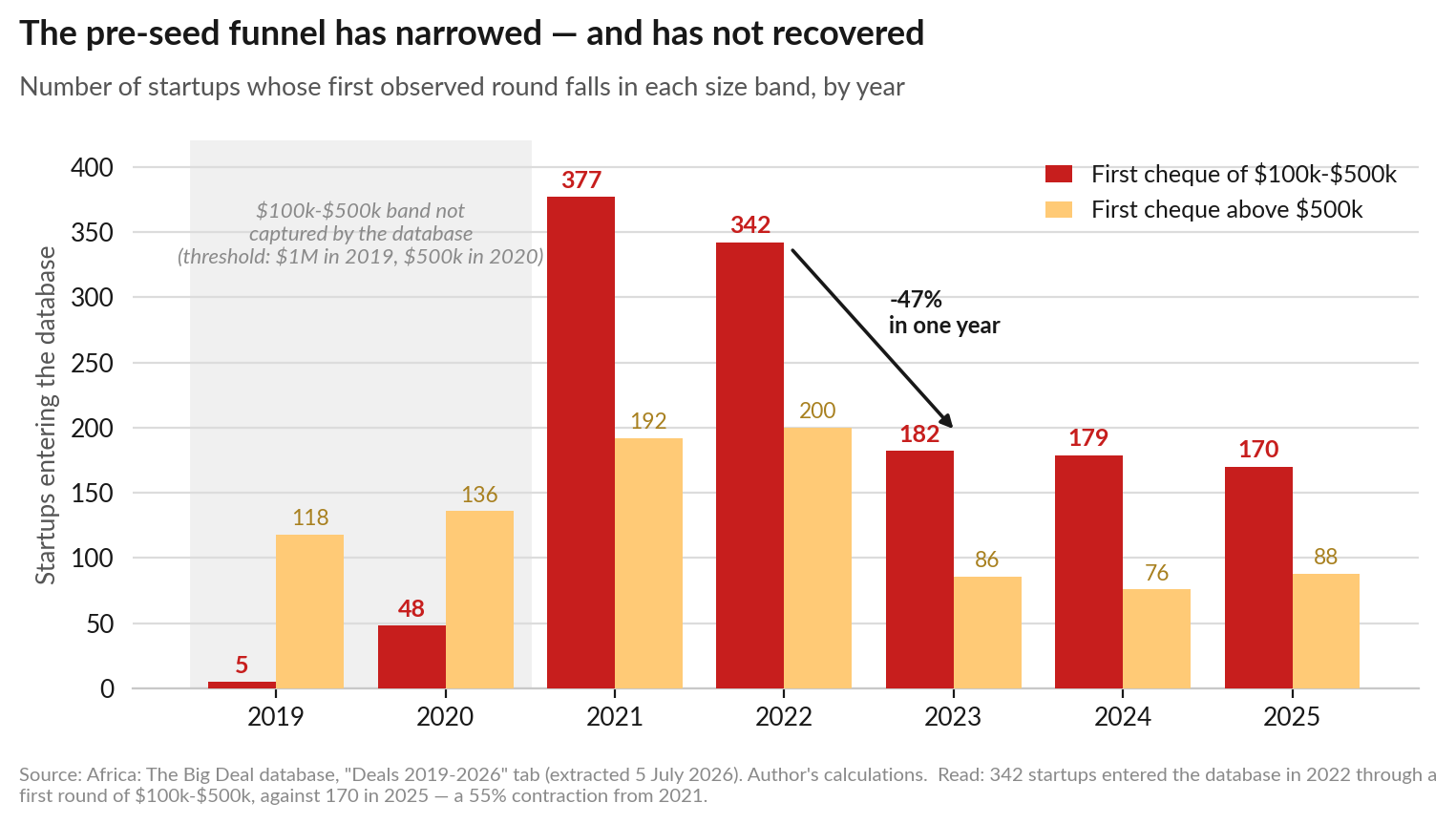
Grégoire de Padirac identifies a striking mismatch in African venture capital. AI has made it cheaper and faster to produce a first prototype, bringing more founders to the starting line, while the $100,000-$500,000 equity cheques that turn those prototypes into companies have been shrinking for three years. Digital Africa’s AI Startup Challenge received more than 400 entries from 40 countries, but the financing layer at the entrance to the funnel is narrowing.
His hand-classification of H1 2026 deals challenges the idea that AI startups are simply absorbing all available capital. Companies using AI received about 14 percent of African startup funding, while genuinely AI-native ventures received less than 2 percent. The money was highly concentrated geographically: 86 percent of AI funding went to Nigeria, Egypt, South Africa, and Kenya, compared with about 58 percent of the wider market.
De Padirac argues that this is part of a global first-cheque squeeze, amplified in Africa by dependence on foreign capital and the absence of a large domestic institutional base. Rational allocators concentrate money in established managers when exits are scarce, but that logic starves the emerging and specialist funds most likely to back new founders. His answer assigns different jobs to different pools of capital: commercial LPs pursue returns, development institutions absorb early ecosystem risk, and African pension funds and insurers become the long-term domestic foundation. The broader lesson is uncomfortable: cheaper company formation does not automatically produce a broader venture market when capital is concentrating farther up the funnel.
Which Investors Will Get Rich From Anthropic’s IPO?
Erin Griffith | The New York Times | September 3, 2026

Erin Griffith uses Anthropic’s expected blockbuster IPO to show how startup investing has changed. The question is not simply whether Anthropic’s public debut will create wealth, but which investors accumulated meaningful exposure while the company was still private. The roster includes Sequoia Capital, Spark Capital, Thrive Capital, Lightspeed Venture Partners, Menlo Ventures, and Iconiq, alongside strategic investors and employees.
The larger story is the layering of modern startup capital. Early venture rounds now give way to huge late-stage financings, secondary transactions, strategic corporate stakes, sovereign pools, and employee liquidity programs long before an IPO. A successful listing can make all of those holders richer, while public investors arrive after much of the private-market repricing has already occurred.
That makes Anthropic a useful companion to this week’s portfolio and market-concentration pieces. The company may become one of history’s largest public offerings, but its cap table shows that access to the defining private companies has itself become a concentrated asset. The IPO opens the door to the public market while crystallizing gains accumulated behind it.
The Series A is dead, Long live the Series A
Author: Jackie DiMonte Published: September 2, 2026
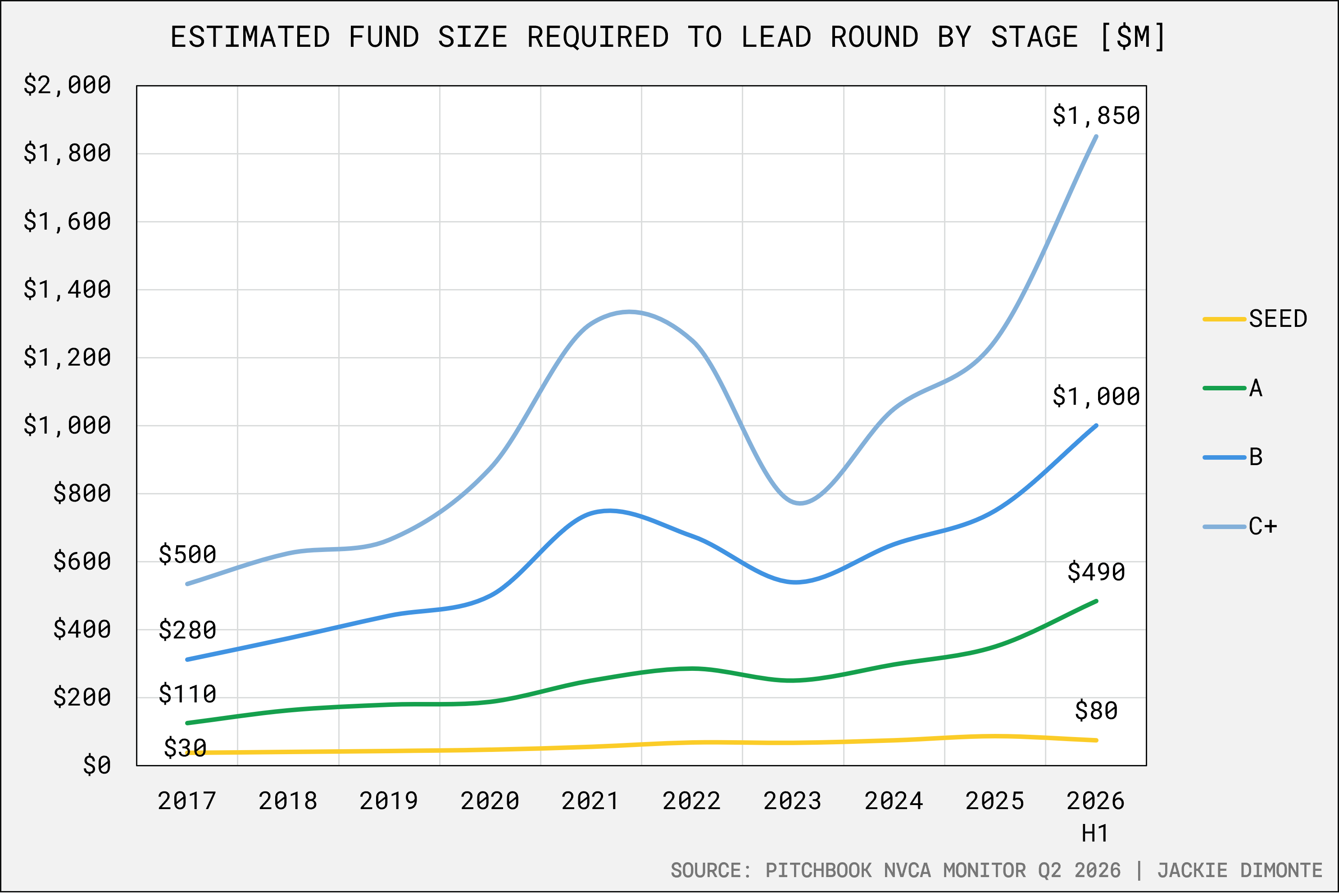
The thesis is that Series A has become a larger, less liquid, and more consensus-driven market, leaving many historically strong companies stranded between speculative ambition and overwhelming traction. DiMonte traces the shift to a reinforcing cycle: round sizes grew, funds grew to lead them, and firms too small for the new Series A moved earlier. The result is more capital chasing a narrower definition of what qualifies as fundable.
The killer detail is the scale of the reset. The median Series A rose from $4.5 million ten years ago to $19.4 million today. Under DiMonte’s assumptions about portfolio size, reserves, fees, and a lead investor funding 70 percent of a round, the number of funds large enough to lead a typical Series A fell from roughly 200 annual fund closes to 50. That shrinkage leaves companies with $3-5 million in revenue and 3-5x annual growth competing against either pre-revenue category bets or companies already growing tenfold.
DiMonte expects the gap to attract concentrated smaller funds, seed investors moving downstream, and private-equity buyers. The market’s next opportunity may sit precisely where the current consensus has stopped looking: companies with sound fundamentals that are neither dream-stage outliers nor obvious hypergrowth winners.
Read more: Source
Humility Hard Hats
Kyle Harrison | Investing 101 | August 29, 2026
Kyle Harrison writes about a recurring founder failure mode in fundraising conversations: a founder asks for feedback, then treats the answer as an attack that must be rebutted. The piece begins with a founder who defended his “say-to-do ratio” after Harrison said investors in the category would want to see a repeated pattern of promise, delivery, promise, delivery before underwriting a larger vision. Harrison says many founders enter “pitch mode,” where disagreement turns into debate instead of learning.
The essay’s main distinction is between debate and risk inventory. Harrison argues that fundraising has no judge, audience, or scoreboard; there is only one person who may or may not wire money. Startup evaluation is therefore less about proving the VC wrong and more about showing which risk dials have moved down. Big promises still matter, but they only work if the delivery foot follows. Otherwise, the founder answers skepticism about traction with an even larger vision, widening the gap between promise and proof.
The caveat is that Harrison does not argue founders should become agreeable or lose conviction. He explicitly says great exceptions exist, that many VCs are wrong, and that deviant founders often need to ignore most feedback. His narrower point is that conviction should not shut off the intake valve. The useful founder posture is “paranoid in private and confident in public”: already aware of how the company could die, calm when someone names a risk, and curious enough to compare notes when free information is offered.
Building Portfolios for Different Types of Risk
Dan Gray | The Odin Times | August 30, 2026
Dan Gray argues that venture portfolio construction should be understood as risk management rather than a simple argument between concentrated talent and diversified humility. He opens from the claim that outsized returns require uncertainty, but that maximizing risk can turn venture capital into trading or gambling. In his account, the harder skill is learning which kinds of risk a strategy is built to absorb and which kinds it is likely to mishandle.
The first half makes the case for diversification. Gray says venture outcomes are hard to predict, with many investments expected to lose money and only a tiny share returning 50x or more. He cites Harry Stebbings saying his predicted top five companies from 20VC Fund I were all wrong three years later, then connects that uncertainty to larger portfolios. Larger portfolios, in Gray’s simulation, improve the odds of good performance, while smaller portfolios retain more exposure to rare great outcomes but make those outcomes less likely.
The second half separates idiosyncratic risk from execution risk. For early-stage investing, Gray says diversified portfolios can help absorb the unpredictable path from unknown idea to outlier. For specialist or later-stage strategies, where the technical category may be better understood and active support matters more, concentration can make sense because investors have limited capacity to lead rounds, take board seats, and help companies execute. His conclusion is not that one strategy is universally right. Venture needs both diversified funds willing to underwrite uncertainty and concentrated investors willing to support execution, with a healthier market equilibrium between the two.
Which Investors Have Backed The Most 2026 Unicorns?
Gené Teare | Crunchbase News | August 19, 2026
Gené Teare examines the investors behind the 250 companies that joined the Crunchbase Unicorn Board through August 15, already exceeding the 193 minted in all of 2025. The class raised $98 billion in total, including $74 billion during 2026, with robotics, AI labs, healthcare, AI infrastructure, and AI deployment driving much of the new company creation. Fifty-six percent of the companies are based in the United States and 19 percent in China.
The leading investors are familiar: Sequoia Capital, Khosla Ventures, Y Combinator, Lightspeed, Founders Fund, Andreessen Horowitz, Bessemer, Lux, and General Catalyst. The surprise is BoxGroup, the only seed specialist in the top 10. It ranked third among seed investors despite backing far fewer companies than YC and operating with funds that are a fraction of Sequoia’s size. At Series A, a16z led the count, followed by Khosla, Spark, and Sequoia.
The data supports both sides of this week’s portfolio argument. Large multistage firms dominate because they combine early access with the capital to keep funding winners as they scale. BoxGroup shows that fund size and brand are not the same as judgment. Concentration works when an investor repeatedly selects the right companies; diversification works when it gives a skilled investor enough shots at a power-law market. Neither strategy becomes good merely by being large.
Nice work.