

There is consensus that 2026 is a consensus VC market.
Exposure to Anthropic and/or OpenAI is increasingly important for multi-stage managers to demonstrate market positioning.
Some AI products have addressable markets that support $1tn+ outcomes. Building these businesses requires enormous amounts of capital. This creates a dynamic where capital is concentrated in a handful of companies from a handful of VCs.
This concentration of capital in established VCs is accelerating the transformation of VC from a cottage industry into an institutional asset class. a16z’s Jen Kha argues for this to run faster still, with a greater allocation of capital from institutional investors into a smaller number of VCs.
The team at Euclid VC point out here that a consequence of VC becoming an asset management business is that “scale is the product and discovery is a legacy feature. Call it the Blackstonification of venture.” Euclid, as an emerging manager, is seeking to reject this development but does not deny it is happening.
In other words, it is quaint to argue about consensus vs non-consensus investing.
This is not to assert that these asset managers do not make non-consensus bets. They continue to invest in uncommercialized categories (such as Coatue investing in Commonwealth Fusion), unloved companies (such as Benchmark investing in Manus despite regulatory concerns) and under appreciated founders (such as a16z investing in Adam Neumann’s Flow).
It is just that access to the consensus companies is now more important than timing. Marc Andreessen’s golden VC rule holds that the error of omission is worse than the error of commission.
Just invest in great companies. a16z’s Martin Casado makes it sound so simple when it comes to delivering VC returns: “The productive view is that good companies have good founders in big markets and smart investors realize that. And the gains are primarily driven by the underlying business. The speculative view is that gains are a function of beating “the market”. I tend to take a productive view. But I understand the speculative view.”
Ensuring access to the best companies becomes even more important as capital is concentrated in outsized winners. The weight of more capital in larger outcomes will matter more to returns for large managers than superior timing in a non-consensus bet.
Considering OpenAI and Anthropic
OpenAI and Anthropic were themselves once considered non-consensus (or “pre-consensus” as a consensus is itself time bound). AMP’s Anjney Midha has been on a recent tirade about how Anthropic’s seed round was passed on by 21 Sand Hill Road firms.
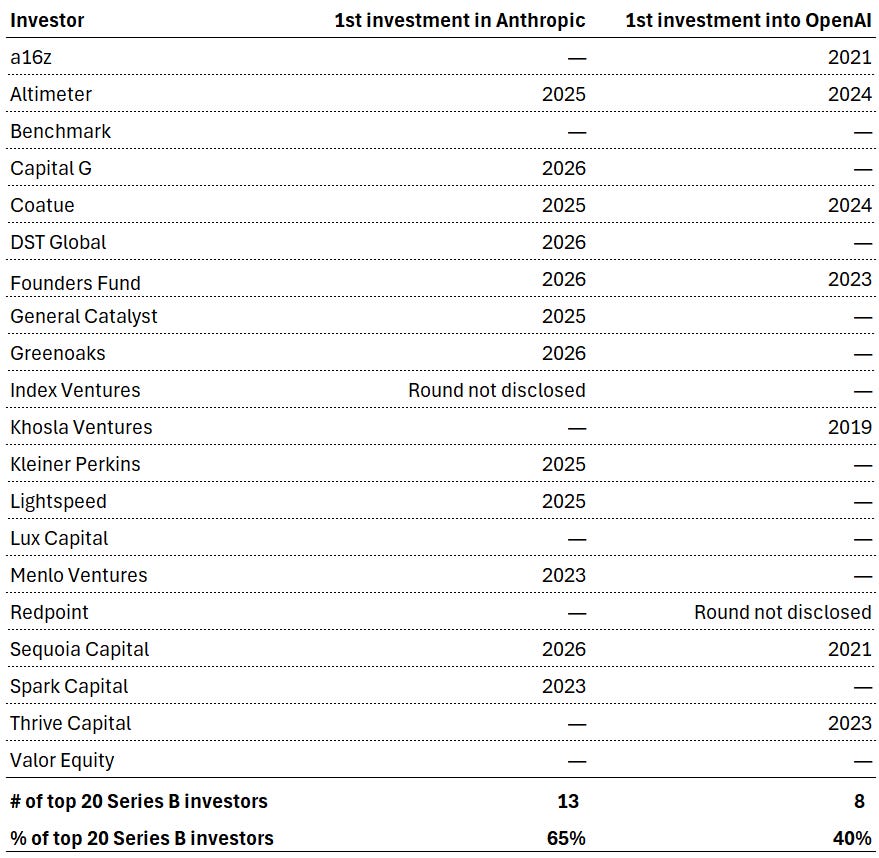
Notable pre-consensus bets were made by Khosla into OpenAI and by Spark/Menlo into Anthropic.
But the larger point is that 17 of the top 20 investors on SignalRank’s model have public positions in either Anthropic and/or OpenAI (see Figure 1).
These are top Series B investors per our model. But most of their access to these two companies comes from later stage initial investments.
If returns are concentrated in a small number of power law companies, then access to those companies (even at a later stage) becomes a prerequisite for capturing the power law.
It is perhaps more notable that of our top 20 Series B investors only Benchmark, Lux & Valor do NOT have public positions in either of these companies and still rank highly. Consensus exposure is common among leading investors but not a prerequisite for ranking highly as a Series B investor on our model.
Figure 1. First publicly identifiable investments into Anthropic / OpenAI by top 20 Series B investors
Source: Public filings; SignalRank
What does this mean for seed managers?
The implications of consensus VC dynamics are different for seed managers, especially as multi-stage funds are now increasingly investing at seed too. What to do?
Three seed managers have made variants of the same argument publicly (Angular’s Gil Dibner here, Chemistry’s Ethan Kurzweil here and 1984’s Ramy Adeeb here). They are arguing there are two divergent paths:
Go earlier still to inception stage and seek to find pre-consensus companies. This can make the portfolio construction math still work for a seed manager (with higher ownership and lower valuations, albeit with ever lower graduation rates). Dibner: “The key here is to distinguish between pure gold and fool's gold.”
Work on non-consensus (truly non-consensus, not pre-consensus) companies where the probability of follow-on funding from consensus VCs is low. As Dibner states, “non-consensus venture is more valuable than ever but we’re all gonna chew glass.” Or in Adeeb’s words: “The infrastructure bet requires you to be right about who wins. The application bet requires you to be right that AI works. Those are very different bets.”
The stark choice is perhaps best summed up by Kurzweil in his title: “Go Big or Go Broke - The Middle Ground is Gone.” Pick a path.
What does this mean for SignalRank?
VC is moving towards becoming an institutional asset class. Like the multi-stage funds, we believe it is possible to deliver consistent VC returns at scale. We just pursue a different strategy.
By the Series B, a company has usually become more legible to institutional capital (and is approaching consensus by Series C).
A qualifying Series B on our model is by definition backed by multiple top ranked VCs. We use that institutional validation to identify companies that are sufficiently legible to underwrite, but still early enough to offer differentiated exposure.
Our objective is to build exposure to a higher percentage of companies that go on to generate 5x+ returns from Series B, across a diversified portfolio and multiple vintages. This is a different approach to multi-stage funds that concentrate capital behind their highest conviction opportunities.
We are not trying to predict the next consensus company. We are trying to systematically own more of the companies that become consensus.